Log the set.
The arithmetic is handled.
StationX is a strength and cardio tracker for Android. It builds your program once, keeps your rotation in order, and works out estimated one-rep max, volume, records and what to lift next from the sets you log.
Barbell Bench Press Target 8 to 12 reps
This runs the app's own rules. Epley: weight × (1 + reps / 30), with no estimate above 12 reps. Progression needs at least two sets at the working weight.
It builds your program once
A new account starts empty: no demo routines, no default plan. Right after you sign up, a short setup asks how you train and generates the program. After that, nothing changes it unless you ask. Not login, not a restart, not finishing a workout.
One recommender, three jobs
The same ranking engine generates each day, orders replacements in Smart Swap, and shows the gentle “this muscle may be under-trained” hints. Ties break by catalogue order, so the same answers come out every time. It also penalises a second exercise of the same movement pattern in a day, which removed double calf raises and a third curl.
Coverage, judged per week
Primary muscles count a full set and assisting muscles half. Levels run from none to high against weekly thresholds, per region and per sub-muscle, shown while you build and on the review step. They are a UI hint, not a medical claim, and they never block saving.
- Beginner is a hard filter that keeps advanced lifts out, with one controlled exception when a muscle would otherwise get no direct work, which Review lists.
- Saving a new schedule archives the old routines. They stay openable, startable and editable, and you can add them back.
- Presets are fitted to you: exercises you cannot do with your equipment are swapped for the closest same-muscle option, or left out when nothing is close.
The rotation waits for you
Most trackers tie a workout to a weekday, so a missed Monday means a wrong Tuesday. StationX keeps a pointer in the rotation instead. It moves only when you finish a workout, so a sick week or a holiday changes nothing.
Finish a different workout from the rotation and the pointer jumps to the one after it. Finish one that is not in the rotation, such as an archived routine, and it stays put. Backdating a session never moves it.
The date you trained is stored apart from the date you entered it, so history, calendars and records follow when you trained.
Logging a session
The logger is built for sweaty thumbs. It shows last time's numbers, offers a suggestion, and gets out of the way.
Quick to log
A numeric keypad, plus and minus steppers (2.5 kg or 5 lb), “same as last set”, and undo when you remove a set. A weighted exercise cannot be ticked at 0 kg; the keypad opens instead. A plate calculator works out plates per side for a barbell target.
Swap mid-workout
Smart Swap ranks replacements by the same sub-muscle, movement pattern, purpose, equipment and your own history, with a match percentage. A toggle widens it to every exercise. Added exercises land in their muscle section.
Never lose a workout
Every change is saved to the phone as a draft, so a crash or a killed app loses nothing, and Today offers Resume. A workout stays open until you finish or discard it. If saving fails, the sets stay and you can retry.
420 exercises, one muscle model
Every built-in exercise has structured muscle targets: a region, a sub-muscle only where it is defensible, and a primary or assisting role. Lat Pulldown is Back, Lats, with biceps and upper back assisting. The muscle map you see is vector art drawn in code, not photos.
There are 12 regions with sub-muscles, from upper, mid and lower chest to the three heads of the deltoid, and 8 workout sections that decide how a workout is grouped. Custom exercises use the same structure through a “Muscles trained” editor.
- Search understands lifters: “rdl” finds Romanian deadlift, and “skull crusher” equals “skullcrusher”.
- Filters: muscle, sub-muscle, equipment, and a Common filter of 39 staple lifts.
- Every exercise has a difficulty of beginner, intermediate or advanced. A test checks that each of the 420 is in exactly one group.
Where the 420 come from
Cardio that fits the sport
Thirty-three activities, from treadmill and rowing to hiking, swimming, boxing and climbing, each showing only the fields that make sense for it. Pace follows each sport's convention: per kilometre, per 500 m for rowing, per 100 m for swimming.
Progress, records and history
Progress compares the current period with the previous one, and cuts the previous period to the same elapsed time mid-period, so a Wednesday is compared with a Wednesday. It shows volume and strength trends, an estimated 1RM chart, a muscle-group breakdown against weekly guidelines, and push and pull balance.
Records are kept per exercise: heaviest weight, most reps, estimated 1RM and highest volume, with the earliest set winning ties. Cardio records are per activity, and a pace record needs at least a kilometre. The calendar shows every session by day and is the entry point for backdating.
Online-first, on purpose
StationX began as an offline app and was rebuilt around an account. Supabase is the only source of truth. There is no guest mode, no local copy of your workouts and no background sync engine. The price is that logging in and saving need a connection. The gain is that the screen never says “saved” before the server has said so.
Finish workout Back + Triceps
5,393 kg volume
- Join the single write queue
- Send one atomic call: session and rotation move together
- Server confirms
- Update the screen
What that costs and buys
- Atomic changes. Finishing a workout and moving the rotation, saving a program with its rotation, first-time setup and delete-all-data are each one database function.
- Safe retries. Ids are made on the phone, so a retry after a lost reply cannot duplicate anything.
- No leaks between accounts. A counter is bumped on every login or logout, and a late reply for the old user is dropped.
- Plain errors. Offline, session expired, rejected and server error each say what happened and that nothing was saved. A request over 20 seconds counts as offline.
- Stays usable. The app re-reads when it returns to the foreground, at most every 30 seconds. A failed refresh shows a small banner and never replaces the screen.
Server
Supabase, PostgreSQL
- 8 tables, each owner-only with Row Level Security
- Routines, sessions, cardio, goals, custom exercises, profile, rotation
- Anonymous requests are denied on every table
- Delete account and delete all data from the app
This phone
Isar, one small record
- The workout or cardio session in progress
- Whether you opted in to Health Connect
- A queue for health writes
- Android auto-backup is off, and logging out clears the draft
Health apps
Health Connect, opt-in
- Reads workouts, heart rate, sleep and resting heart rate
- Writes finished workouts back
- Read data stays on the phone unless you import it
Username and password
No email is collected. The username maps to a private identifier that is never shown and never receives mail. The trade-off is stated on the sign-up screen: there is no password reset, so keep it somewhere safe.
Hard to misconfigure
The build refuses a non-HTTPS address, a Supabase access token, a secret key, or a key that carries the service role. Only the public key can ship in the app. A release build fails without a signing key rather than falling back to a debug key.
Private by default
No analytics, ads, tracking or crash-reporting SDKs. The only network peer is Supabase. Release logs record exception types only, never data.
Health and recovery, if you want them
Everything here is off by default, and the app explains what it will read or write before the system permission sheet appears. Samsung Health works through Health Connect; StationX never talks to Samsung directly. A phone and watch were used to confirm heart rate, workout write-back, sleep and recovery.
- Save workouts. Each finished session becomes one exercise record with only the distance and calories you logged. StationX only ever deletes records it created.
- Import watch workouts. A preview first, then import. Nothing is duplicated, and StationX's own records are excluded. Optional automatic import runs when the app opens.
- Heart rate. A suggested average for a cardio session that you confirm, a live chip while you train, and a 7, 14 or 30 day trend.
- Connection check. A read-only seven-day test that finds the first thing that is not working: store missing, permissions, or no recent data.
A readiness verdict from your own numbers
With sleep and recovery switched on, Today shows whether to push or ease off. It weighs sleep against your target, deep sleep and efficiency, resting heart rate against your own baseline, and recent sleep debt. When a watch records no resting heart rate, it is estimated from heart rate during sleep and labelled as an estimate. Past nights appear on the calendar as moon markers.
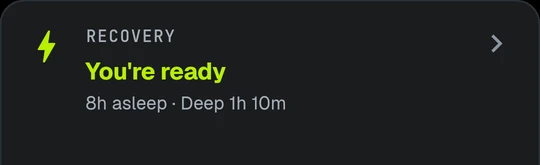
The card on Today. Tap it for the details.
Built so the numbers can be trusted
Maths stays out of widgets
Estimated 1RM, progression, records, volume and coverage are pure Dart in a domain layer with no Flutter and no I/O. Screens read through repository interfaces, so the calculator at the top of this page is running the same rules as the app.
Progression is cautious
It stays quiet on thin history, never suggests a load for bodyweight or timed work, ignores one outlier set, and never asks for more than one extra rep. If you last trained the lift over three weeks ago, it says to start again from that weight.
Honest data
Features that only existed in the design mock-ups, such as GPS, sensors and social, were replaced with plain “not available” states. Health data written or read contains only what you logged or confirmed.
RotationServiceProgressionServicePrServiceVolumeServiceExerciseRecommenderMuscleCoverageSmartSwapServiceScheduleBuilderPlateCalculatorReadinessEngineestimateOneRepMax()
Tested end to end in memory
An in-memory fake of Supabase with per-user isolation and failure injection drives tests for sign-up, login, account switching, double submits, expired sessions, failed writes and stale replies. A manual SQL suite checked the live project's access rules: 22 passes, 0 failures.
Accessible by test
Semantic labels, 48 dp touch targets, contrast tests on the colour tokens, and layout checks down to 280 dp wide at double text size. Animations go through one helper that honours Android's remove-animations setting.
Moving in and out
A one-time importer brings in history from the older Gym Tracker app, matching exercises by name and keeping dates. Importing the same file twice adds nothing. A backup file restores into any account, and JSON or CSV export is built in.
What is not done
- Not tested on a real phone yet: a minified release build, flaky-network saving and long-idle sign-in.
- iOS has never been built. The Apple Health code is written but unrun.
- No offline mode. Without a connection you cannot log in or save; only the workout in progress survives.
- The whole history downloads on login, paged and in parallel. That is fine for thousands of sessions and would need server-side totals beyond that.
- No password reset or email check, by design.
- Out of scope: GPS, sensors, social, nutrition, push notifications and exercise videos.